


Dr. E Manuals
Yamaha XT500 TT500 Service Manual
Yamaha XT500 TT500 Service Manual
Couldn't load pickup availability
Yamaha XT500 TT500 XT500C TT500C XT500D TT500D Service / Repair / Workshop Manual
Instant download after purchase, in PDF form, NOT a physical book.
This manual contains 130 pages in English Language, it is the only manual you will require to maintain, repair and service your Yamaha XT/TT, using this manual you ensure that your motorbike is repaired to manufacturer standards / specification, whether you are using OEM or genuine Yamaha Parts.
Sample pages and table of contents can be seen in the third product picture, please make sure you are happy with the quality of the manuals before purchasing.
Features Chapters: General Information, Periodic Inspections and Adjustments, Engine Overhaul, Carburetion, Chassis, Electrical, Appendices
If you have any issues downloading/accessing your manual, please contact us so we can fix this for you.
Share




XT500/TT500 (1976-1981): "Son of Thumper" — Japan's First Genuine Big Four-Stroke Enduro Single
Bikebound's own retrospective doesn't undersell this bike's genuine historical weight: "introduced in 1976, it was the first big four-stroke 'thumper' from Japan — a 27-horsepower big single brute that was stone-ax reliable." Motocross Action Magazine's own history traces the genuine engineering ambition behind it: Yamaha set out to build "a full-sized, four-stroke, single-cylinder, dirt bike that was similar to the famous British BSA singles in performance but with better reliability," internally code-named the YR400 — with 400cc reserved for the Japanese domestic market under that country's tiered licensing rules, and 500cc chosen for American and export markets.
Power comes from a 499cc air-cooled four-stroke SOHC single, 2 valves, an 87mm x 84mm bore and stroke, and a 9.0:1 compression ratio, fed by a Mikuni VM34SS carburetor (32mm on pre-production and 1977 models), delivering a claimed 27-30 hp at 5,800-6,500 rpm and roughly 29 lb-ft of torque at 5,500 rpm, run through a wet multi-plate clutch and 5-speed transmission. Off-Roading Pro's own coverage confirms this exact engine architecture is shared directly with the contemporary Yamaha SR400 and SR500 street bikes — genuinely the same fundamental single, tuned across three closely related models for three distinct missions.
Motocross Action's own history confirms the XT500 arrived first in late 1975, "a few months later, Yamaha introduced the dirt-focused 1976 TT500 — it was 15 pounds lighter and devoid of the XT500's road equipment," styled like a genuine motocrosser with number plates and a simplified, bulky exhaust system, versus the road-going XT's full lighting and street equipment. Bike-urious's own retrospective captures exactly why this platform became such an unlikely global sales phenomenon: "after the TT500 dedicated off-road version received 5 of the 6 podium places in the first 2 Paris-Dakar rallies (1979 and 1980), XTs sold like hotcakes. They became the standard all-purpose motorcycle on every US ranch, Aussie station, and South African boerderij" — genuine word-of-mouth success built on the bike's remarkable simplicity: "easy to maintain as long as you fed her clean gas, air and oil. Electrics were very simple, major exterior bearings could be repacked through grease nipples, and, well, these things just kept on going."
The chassis uses a half-duplex cradle frame with a telescopic front fork and swingarm rear suspension, braking through drum brakes front and rear, riding on a 3.00-21 front and 4.00/4.60-18 rear tire combination. A forced-pressure dry-sump lubrication system feeds the engine through an oiled polyurethane foam air filter (dry, foam rubber on the 1978 model specifically). Bike-urious's own long-term ownership account flags a genuine, well-known engineering quirk worth knowing for anyone servicing one: "the engine had two small design flaws — oil feed to the rockers leaves the exhaust side under-lubricated," a detail that's kept many restorers and long-term owners attentive to top-end oil delivery over the decades. This platform ran through 1981 before Yamaha replaced it with a four-valve engine design, closing out the fundamental architecture that had, by Off-Roading Pro's own account, laid the genuine blueprint for every XT-series adventure bike that followed, right up through the later XT660Z Ténéré.
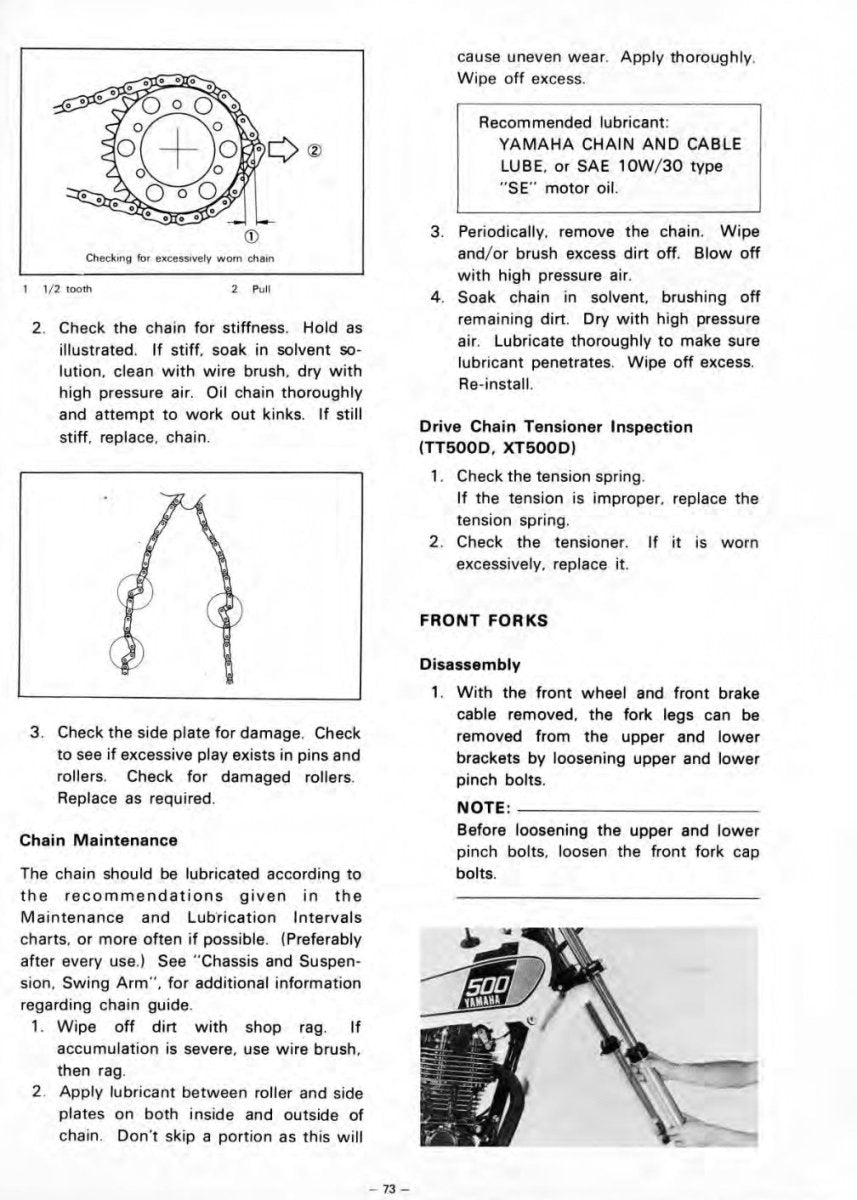
This factory service manual covers the procedures, torque specs, and diagrams needed to keep a 1976-1981 XT500/TT500's engine and driveline running the way Yamaha built it.
-
Manual Sourcing
We strive to use freely available sources. Some manuals may be scans or photocopies of older originals. Sample previews are shown on the product page, please review them before purchase to ensure quality meets your needs.
-
Copyright
This material is shared in accordance with the GNU General Public License (GPL), GNU Lesser General Public License (LGPL), or designated as Freeware, all of which allow free and open distribution. Additional information is available on our Copyright & Content Disclaimer Page
-
Refunds
Due to the nature of digital products, all sales are final. We recommend reviewing the sample preview on the product page to ensure the manual meets your expectations before purchase. Refunds will not be issued for issues related to content quality already disclosed or shown in the preview.
