


Dr. E Manuals
Knight-Kit Star Roamer Receiver Shortwave Radio Owner's Operator Manual
Knight-Kit Star Roamer Receiver Shortwave Radio Owner's Operator Manual
Couldn't load pickup availability
Knight-Kit Star Roamer Receiver Shortwave Radio Owner's Operator Manual
Instant download after purchase, in PDF form, NOT a physical book.
This manual contains 35 pages in English Language, it is the only manual you will require to maintain and repair your Knight-Kit Star Roamer Receiver Shortwave Radio.
Sample pages and table of contents can be seen in the third product picture, please make sure you are happy with the quality of the manuals before purchasing.
If you have any issues downloading/accessing your manual, please contact us so we can fix this for you.
Share


Star Roamer: The $39.95 Kit That Introduced a Generation of Shortwave Listeners to the Hobby
Electronics Illustrated's own November 1964 review told the story simply, and OneTubeRadio's retrospective captures why it still matters: "many SWL's got their start with the four-tube receiver." The Star Roamer was ubiquitous through the 1960s and into the '70s — a genuine entry point into shortwave listening for a whole generation of hobbyists, sold as a $39.95 kit that took roughly 20 hours for a first-time builder to assemble.
Built around a transformer-operated, single-conversion superheterodyne circuit, the Star Roamer runs just four tubes: a 6BE6 converter, a 6HR6 IF amplifier, a 12AX7 dual-triode audio preamp, and either a 6AR5 or 6AK6 audio output tube. A selenium rectifier handles the half-wave HT power supply, while a pair of 0A74A germanium diodes cover the detector and noise-limiter stages — genuinely minimalist circuitry for the era, which is exactly what kept the kit affordable and approachable for beginners. Continuous coverage runs from 200 kHz to 400 kHz on longwave, then 550 kHz through 30 MHz across four additional bands (540-1800 kHz, 1.8-4.8 MHz, 4.8-12 MHz, and 12-30 MHz).
A RadioReference forum contributor's own long-term assessment puts the Star Roamer's real-world performance in context: "when well built, it is a decent performer, certainly on par with, or slightly better than, the National NC-60 Special" — genuinely solid results for a budget kit radio, though performance depended heavily on the builder's own soldering care and attention to detail. Electrical bandspread tuning (via a separate 0-100 calibrated condenser rather than marked frequencies) let listeners fine-tune within a band, while the final IF stage was deliberately designed to break into oscillation, giving the set quasi-regenerative CW and SSB reception without a dedicated BFO circuit. A key jack on the chassis let the same oscillating stage double as a code practice oscillator — a genuinely thoughtful touch for the many novice operators the Star Roamer was aimed at, who were often working toward their own amateur radio license alongside their shortwave listening.
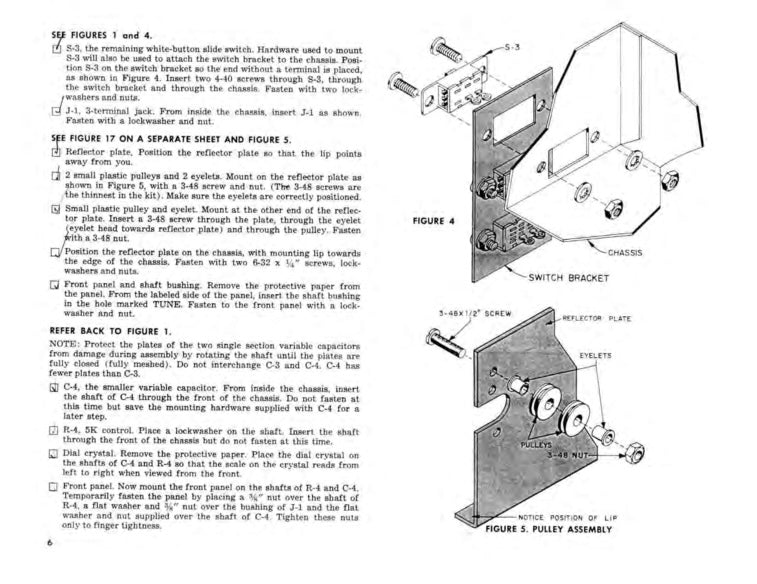
This owner's operator manual covers the assembly, alignment, and operating procedures needed to build and run a Knight-Kit Star Roamer the way Allied Radio designed it.
-
Manual Sourcing
We strive to use freely available sources. Some manuals may be scans or photocopies of older originals. Sample previews are shown on the product page, please review them before purchase to ensure quality meets your needs.
-
Copyright
This material is shared in accordance with the GNU General Public License (GPL), GNU Lesser General Public License (LGPL), or designated as Freeware, all of which allow free and open distribution. Additional information is available on our Copyright & Content Disclaimer Page
-
Refunds
Due to the nature of digital products, all sales are final. We recommend reviewing the sample preview on the product page to ensure the manual meets your expectations before purchase. Refunds will not be issued for issues related to content quality already disclosed or shown in the preview.
