


Dr. E Manuals
Honda XR250R 1986-1995 Service Manual
Honda XR250R 1986-1995 Service Manual
Couldn't load pickup availability
Honda XR250R 1986 - 1995 Service / Repair / Workshop Manual
Instant download after purchase, in PDF form, NOT a physical book.
This manual contains 258 pages in English Language, it is the only manual you will require to maintain and repair your Honda XR250R, using this manual you ensure that your motorbike is repaired to manufacturer standards / specification, whether you are using OEM or genuine Honda Parts.
Suits Models from 1986, 1987, 1988, 1989, 1990, 1991, 1992, 1993, 1994 and 1995.
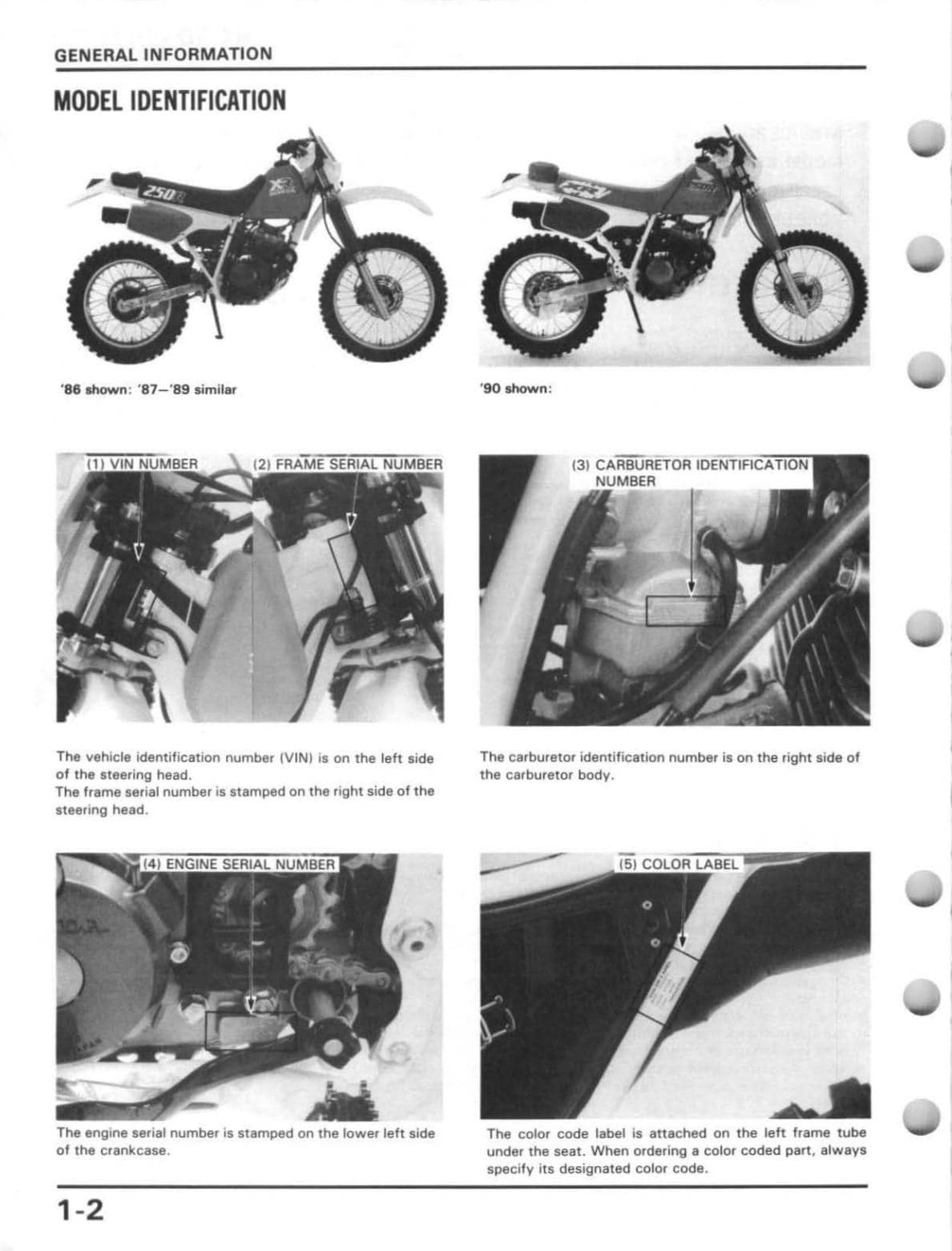
Sample pages and table of contents can be seen in the third product picture, please make sure you are happy with the quality of the manuals before purchasing.
Features Chapters: General Information, Lubrication, Maintenance, Fuel System, Engine Removal/Installation, Cylinder Head/Valves, Cylinder/Piston, Clutch/Kickstarter, Alternator, Crankcase/Crankshaft/Balancer, Transmission, Front Wheel/Suspension/Steering, Rear Wheel/Brake/Suspension, Hydraulic Brake, Rear Fender/Exhaust.
If you have any issues downloading/accessing your PDF manual, please contact us so we can fix this for you.
Share



XR250R (1986-1995): The Single-Carburetor Generation That Bridged RFVC's Debut and the 1996 Chassis Overhaul
Wikipedia's own account of the broader XR250R lineage confirms exactly where this range fits: introduced with an all-new RFVC engine in 1984, "in 1986, the engine received a single carburetor instead of the dual progressively opening units of the 1984 and 1985 models" — a genuine simplification that defines this exact 1986-1995 range as a distinct configuration from both the dual-carb 1984-1985 launch bikes and the suspension-overhauled 1996-2004 generation that followed.
Power comes from a 249cc air-cooled SOHC single-cylinder engine with Honda's RFVC four-valve combustion chamber design, a 73mm x 59.5mm bore and stroke, and a 10.2:1 compression ratio, delivering a claimed 24.56 hp at 8,000 rpm and roughly 16.85 lb-ft of torque at 7,000 rpm — figures genuinely lower than the earlier dual-carb 1984-1985 configuration's claimed 30 hp, a deliberate detuning that accompanied the switch to simpler single-carburetor fueling. Motocross Hideout's own jetting reference confirms the specific carburetor spec unique to this exact range: "for '86-'95 models, stock is 40 pilot jet and 125 main jet" — genuinely different calibration from the 45 pilot/132 main setup used on the later 1996-onward bikes, an important distinction before assuming jetting carries over between generations.
Wikipedia's own detailed suspension specification confirms this range ran genuinely less sophisticated front-end hardware than what followed: "41mm damper rod forks with 11 in (280 mm) of travel. Has base valve compression clicker. Cartridge emulator ready" — simpler damper-rod technology (versus the cartridge-type forks introduced with the 1996 redesign), though still delivering the same substantial 280mm of travel front and rear that defined the platform's genuine off-road capability throughout this era. HandWiki's own technical account confirms the fundamental architecture stayed consistent across this whole span: a genuine 6-speed transmission with chain final drive, kickstart-only operation, stator ignition, and the platform's distinctive two-into-one header pipe — "unusual for a single-cylinder engine" — carried unchanged from the 1984 RFVC introduction right through to the 1996 chassis overhaul.
BraapAcademy's own buyer's guide offers genuinely balanced perspective on shopping this exact era versus the later, more refined bikes: "the best years for Honda XR250R were 1996-2004, however, the 1986-1996 editions weren't lemons. If you find a used bike in the 86-96 range, just make sure you like the feel, make sure it's been well cared for, and you should have a decent dirt bike for not a lot of money." A closely related XR250L street-legal variant, introduced in 1991 and running electric start alongside softer suspension and pillion pegs, shared this same fundamental single-carb RFVC engine architecture throughout the overlapping years of this range — genuinely useful parts and service crossover for anyone working across both the competition-focused R and street-legal L variants sold during this era.
This factory service manual covers the procedures, torque specs, and diagrams needed to keep a 1986-1995 XR250R's engine and driveline running the way it was built to.
-
Manual Sourcing
We strive to use freely available sources. Some manuals may be scans or photocopies of older originals. Sample previews are shown on the product page, please review them before purchase to ensure quality meets your needs.
-
Copyright
This material is shared in accordance with the GNU General Public License (GPL), GNU Lesser General Public License (LGPL), or designated as Freeware, all of which allow free and open distribution. Additional information is available on our Copyright & Content Disclaimer Page
-
Refunds
Due to the nature of digital products, all sales are final. We recommend reviewing the sample preview on the product page to ensure the manual meets your expectations before purchase. Refunds will not be issued for issues related to content quality already disclosed or shown in the preview.
