


Dr. E Manuals
Honda XL400 XL500 1983-1984 Service Manual
Honda XL400 XL500 1983-1984 Service Manual
Couldn't load pickup availability
Honda XL400 XL500 1983 - 1984 Service / Repair / Workshop Manual
Instant download after purchase, in PDF form, NOT a physical book.
This manual contains 100 pages in English Language, it is the only manual you will require to maintain and repair your Honda XL, using this manual you ensure that your motorbike is repaired to manufacturer standards / specification, whether you are using OEM or genuine Honda Parts.
Suits Models from 1983 and 1984.
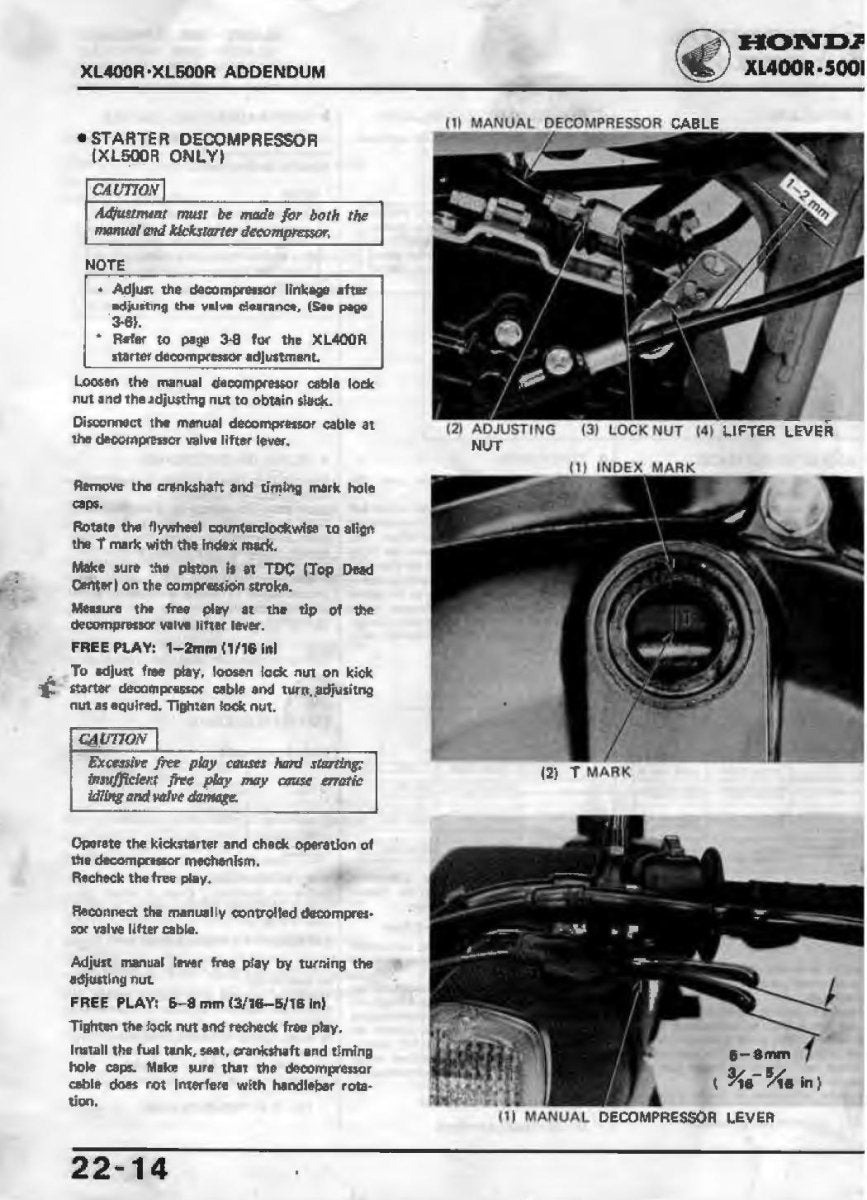
Sample pages and table of contents can be seen in the third product picture, please make sure you are happy with the quality of the manuals before purchasing.
Features Chapters: General Information, Lubrication, Inspection and Adjustment, Fuel System, Cylinder Head, Clutch/Oil Pump, A.C. Generator, Front Wheel/Brake/Suspension/Steering, Rear Wheel/Brake/Suspension, Battery/Charging System, Ignition System, Switches, Technical Features, Wiring Diagram
If you have any issues downloading/accessing your manual, please contact us so we can fix this for you.
Share



XL500R (1983-1984): The Final Chapter of Honda's Original Big-Bore Dual-Sport Single Before RFVC Took Over
MotorcycleDB's own retrospective sums up the genuine appeal of this exact generation plainly: "its air-cooled 497cc engine delivers modest power with excellent fuel efficiency and durability. Known for its lightweight frame, comfortable ergonomics, and proven dependability, it excels in mixed terrain and long-distance exploration." Ultimatespecs' own data confirms this 1983-1984 span represents the final, most mature iteration of the pre-RFVC XL500R engine architecture before Honda's next-generation big-bore dual-sport singles (the XL600R and its four-valve RFVC head) took over the top of the range.
Power comes from a 498cc air-cooled single-cylinder engine, delivering a claimed 27 hp at 5,500 rpm through a 5-speed transmission — a genuine step down from the earlier 1982 model's claimed 33 hp, reflecting a deliberate retuning toward smoother, more usable low-end delivery and improved reliability rather than chasing outright peak output in this platform's final production years. Motorbikecatalog's own detailed spec archive confirms this exact 27-hp tune carried consistently across both the 1983 and 1984 model years, with a claimed top speed around 83 mph — genuinely adequate performance for a big-bore enduro built primarily around real off-road capability and long-distance touring durability rather than outright speed.
The chassis rode on a genuinely dual-purpose 21-inch front and 17-inch rear wheel combination, with the 1984 model year specifically documented running a single front disc brake paired with a rear drum — a real braking upgrade over the earlier 1983 configuration, which some sources confirm ran drum brakes at both wheels. Suspension consisted of a telescopic front fork paired with a rear monoshock, delivering genuinely long-travel, off-road-capable wheel control appropriate for a machine built to handle both paved commuting and serious unpaved trail riding. The closely related XL400R, sold primarily in Japan's domestic market, shared this identical fundamental chassis and running-gear architecture at a reduced displacement specifically to satisfy that market's tiered motorcycle licensing structure — a genuinely common Honda practice of the era, meaning much of the chassis, suspension, and brake service information in this manual applies directly across both displacement variants despite their different engine specifications. This generation represents the last of Honda's original two-valve big-bore XL enduro architecture before the company's four-valve RFVC engine technology, already proven on the smaller XL250R and XR-series off-road bikes, was extended to the larger-displacement XL600R the following year.
This factory service manual covers the procedures, torque specs, and diagrams needed to keep a 1983-1984 XL400/XL500R's engine and driveline running the way it was built to.
-
Manual Sourcing
We strive to use freely available sources. Some manuals may be scans or photocopies of older originals. Sample previews are shown on the product page, please review them before purchase to ensure quality meets your needs.
-
Copyright
This material is shared in accordance with the GNU General Public License (GPL), GNU Lesser General Public License (LGPL), or designated as Freeware, all of which allow free and open distribution. Additional information is available on our Copyright & Content Disclaimer Page
-
Refunds
Due to the nature of digital products, all sales are final. We recommend reviewing the sample preview on the product page to ensure the manual meets your expectations before purchase. Refunds will not be issued for issues related to content quality already disclosed or shown in the preview.
