


Dr. E Manuals
Honda CX500 1978-1982 Service Manual
Honda CX500 1978-1982 Service Manual
Couldn't load pickup availability
1978-1982 Honda CX500 CX 500 Service / Repair / Workshop Manual
Instant download after purchase, in PDF form, NOT a physical book.
This manual contains in English Language, it is the only manual you will require to maintain, repair and service your Honda CX500.
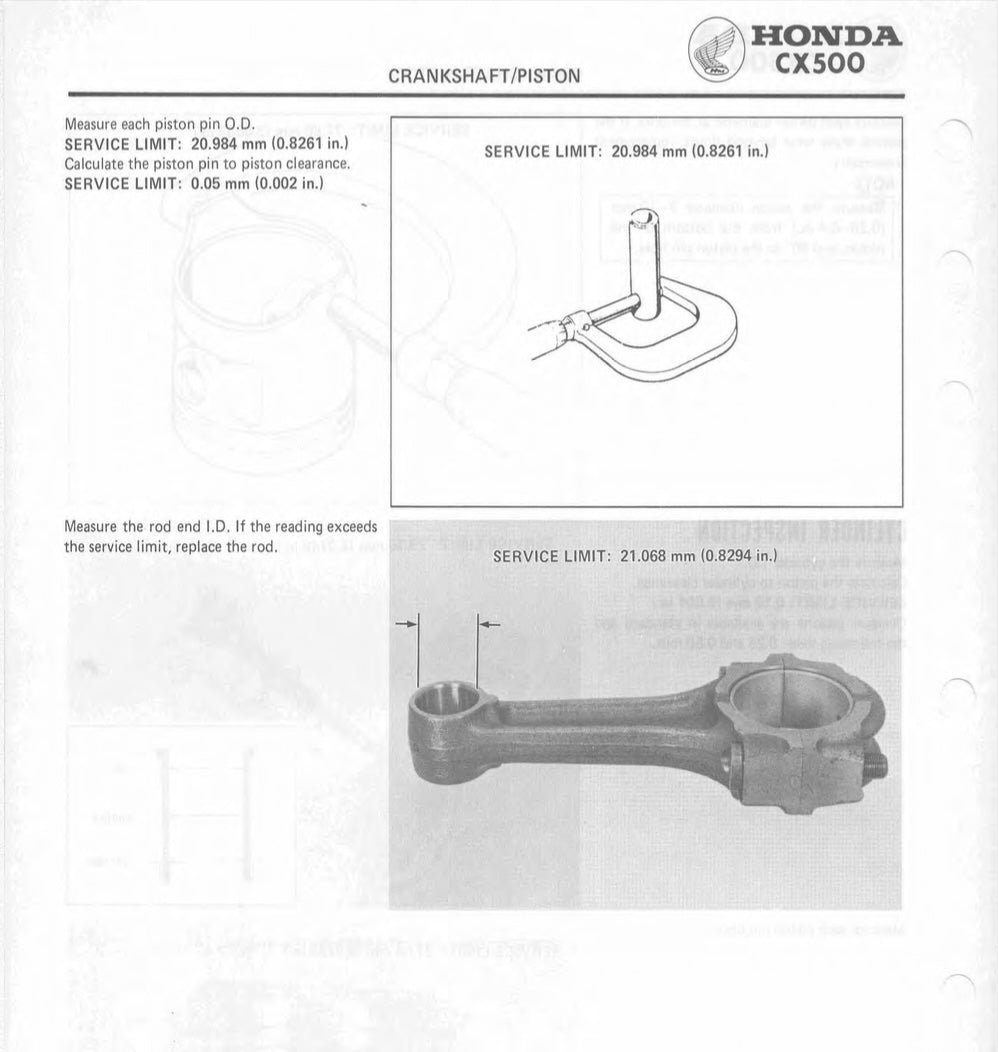
Sample pages and table of contents can be seen in the third product picture, please make sure you are happy with the quality of the manuals before purchasing.
Features Chapters: general information, lubrication, inspection and adjustment, fuel system, engine removal/installation, cylinder head/valve, clutch/oil pump, a.c. generator/flywheel/rear cover, cooling system, camshaft/cam chain, transmission, crankshaft/piston, front wheel/suspension, rear wheel/brake/final drive/suspension, hydraulic disc brake, battery/charging system, ignition system, starter system, technical features, troubleshooting, '79 addendum, '79 deluxe/custom addendum, '80 deluxe/custom addendum, '81 deluxe/custom addendum, '82 custom addendum
Suits Models from 1978, 1979, 1980, 1981 and 1982.
If you have any issues downloading/accessing your manual, please contact us so we can fix this for you.
Share



CX500 (1978-1982): Honda's Odd-Looking V-Twin That Became a Cult Classic
When Honda unveiled the CX500 in 1978, reviewers didn't quite know what to make of it — Cycle Guide's own first-look review called the styling "quite a shock," and one tester famously described the engine as looking "like an air compressor." It looked, as one retrospective put it, like a cross between a Honda and a Moto Guzzi, and the nickname that stuck — "manure pump" — wasn't exactly a compliment. Underneath the unusual looks, though, was a genuinely innovative machine that went on to earn a devoted following, especially among UK dispatch riders who valued its shaft-drive reliability above all else.
Power comes from a 497cc liquid-cooled 80-degree V-twin, longitudinally mounted with the crankshaft in line with the frame, four-valve heads twisted 22 degrees to keep the carburetors clear of the rider's knees, and a 5-speed transmission with shaft final drive positioned below the crankshaft to lower the center of gravity. Output sits at a claimed 48-50 hp at 9,000 rpm, delivering a genuinely strong 106-111 mph top speed for a mid-size tourer of the era and 45-55 mpg fuel economy. The CX500 also holds a genuine first in production motorcycling: it was the first bike fitted with tubeless tires from the factory.
The range expanded significantly across this span — the original 1978 Standard model, a smaller-tanked Custom with buckhorn bars added in 1979, and the fairing-less Deluxe joining that same year, before the Standard was dropped in 1980. Comstar wheels, a steel backbone frame using the engine as a stressed member, and telescopic forks with adjustable rear shocks (later Pro-Link monoshock on updated variants) rounded out the chassis across the model years. Cycle Guide praised the handling as excellent even in that first, skeptically-received 1978 test, singling out steering that felt "wonderfully neutral and light."
This factory service manual covers the procedures, torque specs, and diagrams needed to keep a 1978-1982 CX500's engine and driveline running the way Honda built it.
-
Manual Sourcing
We strive to use freely available sources. Some manuals may be scans or photocopies of older originals. Sample previews are shown on the product page, please review them before purchase to ensure quality meets your needs.
-
Copyright
This material is shared in accordance with the GNU General Public License (GPL), GNU Lesser General Public License (LGPL), or designated as Freeware, all of which allow free and open distribution. Additional information is available on our Copyright & Content Disclaimer Page
-
Refunds
Due to the nature of digital products, all sales are final. We recommend reviewing the sample preview on the product page to ensure the manual meets your expectations before purchase. Refunds will not be issued for issues related to content quality already disclosed or shown in the preview.
