


Dr. E Manuals
Honda CBX1000 CBX 1000 Service Manual
Honda CBX1000 CBX 1000 Service Manual
Couldn't load pickup availability
Honda CBX1000 1979 1980 Service / Repair / Workshop Manual
Instant download after purchase, in PDF form, NOT a physical book.
This manual contains 326 pages in English Language, it is the only manual you will require to maintain and repair your Honda CBX1000, using this manual you ensure that your motorbike is repaired to manufacturer standards / specification, whether you are using OEM or genuine Honda Parts.
Features Chapters: General Information, Lubrication, Inspection and Adjustment, Fuel System, Engine Removal/Installation, Cylinder/Piston, Clutch Gear Shift Linkage, Crankcase, Transmission Oil Pump, Crankshaft/Primary Shaft, Front Wheel/Suspension, Rear Wheel/Suspension, Hydraulic Brake, Battery/Charging System, Ignition System, Electric Starter, Switches, Technical Features, Troubleshooting, '80 CBX Addendum and includes full wiring diagram.
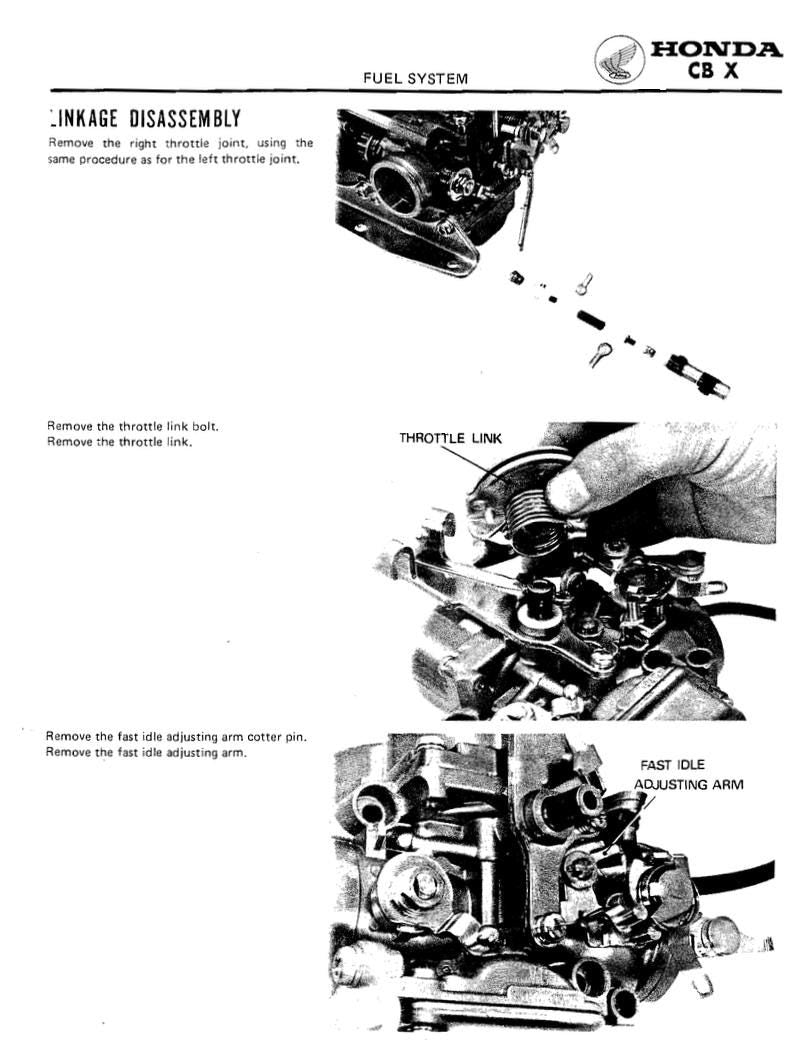
Sample pages and table of contents can be seen in the second product picture, please make sure you are happy with the quality of the manuals before purchasing.
If you have any issues downloading/accessing your manual, please contact us so we can fix this for you.
Share




CBX1000 (1978-1982): "Sang Like an Old F1 Car" — Honda's Genuine Overengineered Masterpiece That Became a Cult Classic in Spite of Itself
HotCars' own retrospective doesn't undersell how genuinely radical this bike's arrival felt in 1978: "enter the CBX1000; iconic, overengineered, and often regarded as the best-sounding production motorcycle in existence... equipped with six cylinders of Japanese goodness sure to get it noticed wherever it went. That complexity would ultimately bring about its downfall, though, while also turning it into a cult classic phenom further down the road." Motorcycle Classics' own account confirms Honda's genuine motivation: with the CB750's dominance long since eclipsed by the Kawasaki Z1 and other rivals, "Honda didn't need to dig too deeply to create the technology for the Honda CBX 1000" — drawing directly on the company's own six-cylinder Grand Prix racing heritage from the RC166.
Power comes from a 1,047cc air-cooled inline-six, DOHC with 24 valves, delivering a claimed 103-105 hp at 9,000 rpm and roughly 62-70.5 lb-ft (84-95 Nm) of torque at 6,500-7,500 rpm, fed by six 28mm Keihin carburetors with an accelerator pump, run through a 5-speed transmission with chain final drive. HotCars' own detailed history confirms the genuine performance milestone this delivered: "that made it the fastest production motorcycle in the world, at least until the Suzuki Katana came out," reaching a claimed top speed around 218-220 km/h (135-137 mph). BikeAdvice's own retrospective confirms the genuinely serious engineering challenges Honda had to solve fitting such a wide engine into a motorcycle frame: "because the engine was massive and wide, Honda engineers had to make various unconventional changes. The ignition equipment was positioned behind the cylinder block and there was a jackshaft that provided the drive to the alternator... there was even a special side frame for it."
HotCars' own account confirms a genuinely surprising engineering discovery from Honda's own development process: "interestingly, a similarly-sized but noticeably lighter four-cylinder engine Honda tested at the time only made 5 hp less" than the six — meaning the CBX's genuine appeal was never really about outright performance efficiency, but rather the character and sound Honda's own engineers fell in love with. HotCars' own coverage confirms exactly why this engine earned its legendary reputation: "some have compared it to old-school Formula 1 car exhaust," and Motorcycle Classics' own account confirms the engine's genuinely remarkable smoothness — a detail HotCars separately notes let owners "balance a coin on it sideways at idle and lower revs," a real testament to the inline-six's inherent primary and secondary balance.
Autoevolution's own coverage confirms a genuine mid-cycle repositioning within this range: "in 1982, the Japanese motorcycle manufacturer repositioned the CBX into the sport touring section with the CBX-B model that packed a detuned engine to 98 hp and the addition of a Pro-Link monoshock absorber on the rear, a 39mm air-adjustable front fork, a stronger frame, and a fairing with optional panniers" — MotorBiscuit's own account confirms this transformation: "the Honda CBX 1000 Super Sport came with an extensive wind fairing, hard-sided saddlebags, and an adjustable rear mono-shock," a genuine shift from the original standard-styled naked six to a dedicated touring machine in its final production year. The 1978 launch model ran an air-assisted front fork with 160mm of travel and dual rear shocks with 100mm of travel, braking through dual 276mm front discs and a single 296mm rear disc — genuinely conventional chassis hardware built specifically to handle the weight and character of that extraordinary six-cylinder engine at the heart of the whole machine, weighing a substantial 250kg dry.
This factory service manual covers the procedures, torque specs, and diagrams needed to keep a 1978-1982 CBX1000's six-cylinder engine and driveline running the way it was built to.
-
Manual Sourcing
We strive to use freely available sources. Some manuals may be scans or photocopies of older originals. Sample previews are shown on the product page, please review them before purchase to ensure quality meets your needs.
-
Copyright
This material is shared in accordance with the GNU General Public License (GPL), GNU Lesser General Public License (LGPL), or designated as Freeware, all of which allow free and open distribution. Additional information is available on our Copyright & Content Disclaimer Page
-
Refunds
Due to the nature of digital products, all sales are final. We recommend reviewing the sample preview on the product page to ensure the manual meets your expectations before purchase. Refunds will not be issued for issues related to content quality already disclosed or shown in the preview.
