


Dr. E Manuals
Honda CB900C CB900F CB900 1980-1982 Service Manual
Honda CB900C CB900F CB900 1980-1982 Service Manual
Couldn't load pickup availability
Honda CB900C CB900F CB900 1980-1982 Service / Repair / Workshop Manual
Instant download after purchase, in PDF form, NOT a physical book.
This service manual contains 411 pages in English Language, it is the only manual you will require to maintain, repair and service your 1980-1982 Honda CB900, using this manual you ensure that your motorbike is repaired to manufacturer standards / specification, whether you are using OEM or genuine Honda Parts.
Suits Models from 1980, 1981 and 1982.
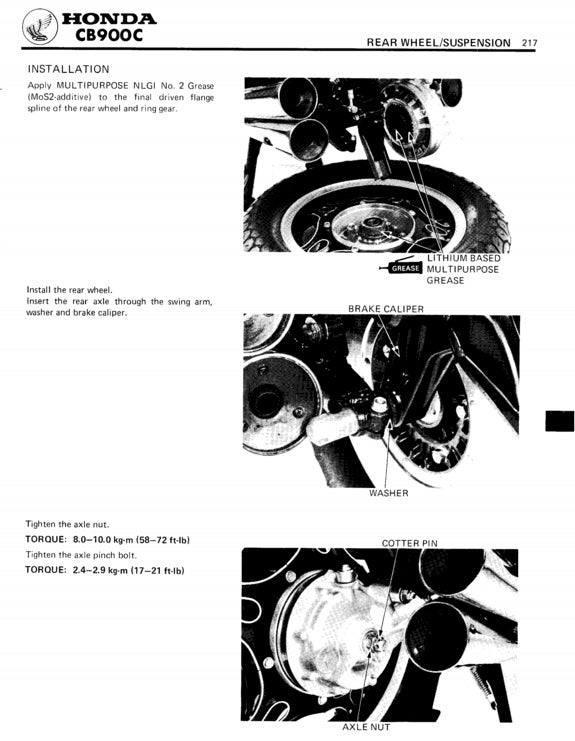
Sample pages and table of contents can be seen in the third product picture, please make sure you are happy with the quality of the manuals before purchasing.
Features Chapters: General information, lubrication, inspection and adjustment, fuel system, engine removal/installation, cylinder head/valve, cylinder/piston, clutch, gearshift linkage, subtransmission, crankcase, transmission, crankshaft/primary shaft, front wheel/suspension, rear wheel/suspension, final drive, hydraulic brake, battery/charging system, ignition system, electric starter, switches, technical features, troubleshooting, *81 cb900 addendum, *81 cb900f addendum, '82 cb900c • f addendum.
If you have any issues downloading/accessing your manual, please contact us so we can fix this for you.
Share




CB900C/CB900F (1980-1982): One Engine, Two Completely Different Motorcycles
Honda essentially hijacked the same engine to build two bikes with opposite personalities. Motorcycle Classics' own retrospective calls the CB900C's mission blunt: as the "Factory Custom" niche exploded in 1980, Honda stretched its proven 750cc four-valve inline four to 900cc and laid back the ergonomics — pulled-back bars, stepped seat, forward pegs — to compete against Suzuki's GS850/1100GL and Yamaha's XS1100 Special. The CB900F, sold in the US market for just 1981-1982 (after several years of European-only availability), took the exact opposite approach: a genuine sport bike Cycle magazine called "one of the best performance buys on the market," praised for "broad, generous power, and accurate, inspiring handling."
Both share the 901-902cc air-cooled DOHC inline-four architecture, 16 valves, pent-roof combustion chambers, fed by four carburetors — but the C runs a genuinely more complex driveline: a crossover shaft system incorporating two pairs of gears, giving it a 2-speed "Select Range" secondary transmission in its own transfer case with a dedicated trochoidal oil pump. Cycle magazine counted "20 gears, six shafts, a dozen bearings, three torque cushions, a U-joint and assorted couplings" in the full crank-to-rear-wheel connection — genuinely elaborate engineering that delivered 10 effective forward gears and reported 50 mpg fuel economy when kept in high range. The CB900F, by contrast, stuck with a straightforward chain-drive 5-speed gearbox, delivering a claimed 89-95 hp at 8,500-9,000 rpm and a genuine 139 mph top speed in period testing — none of the C's mechanical complexity, all of it aimed at outright performance.
Chassis hardware reflects the same divergent missions: the CB900C ran front and rear air-assisted suspension with the TRAC anti-dive system (shared with the later 1983 CB1100F) and shaft final drive, tipping the scales at a substantial 259kg (571 lbs) dry. The CB900F used a steel twin-downtube frame with air-assisted telescopic forks and adjustable twin rear shocks, weighing meaningfully less at 233-241kg depending on model year, riding on Bridgestone Mag Mopus tires. 1982 brought detail updates to the F specifically: graphics matching the CB750F, a new petcock with integrated fuel strainer, and updated Bridgestone tire fitment.
This factory service manual covers the procedures, torque specs, and diagrams needed to keep a 1980-1982 CB900C or CB900F running the way it was built to.
-
Manual Sourcing
We strive to use freely available sources. Some manuals may be scans or photocopies of older originals. Sample previews are shown on the product page, please review them before purchase to ensure quality meets your needs.
-
Copyright
This material is shared in accordance with the GNU General Public License (GPL), GNU Lesser General Public License (LGPL), or designated as Freeware, all of which allow free and open distribution. Additional information is available on our Copyright & Content Disclaimer Page
-
Refunds
Due to the nature of digital products, all sales are final. We recommend reviewing the sample preview on the product page to ensure the manual meets your expectations before purchase. Refunds will not be issued for issues related to content quality already disclosed or shown in the preview.
