


Dr. E Manuals
Ford Escape 2013-2019 Service Manual
Ford Escape 2013-2019 Service Manual
Couldn't load pickup availability
Ford Escape 2013-2019 Service / Repair / Workshop Manual
Instant download after purchase, in PDF form, NOT a physical book.
This service manual contains 4957 pages in English Language, it is the only manual you will require to maintain, repair and service your 2013-2019 Ford Escape, using this manual you ensure that your vehicle is repaired to manufacturer standards / specification, whether you are using OEM or genuine Ford Parts.
Suits Ford Escape Models from 2013, 2014, 2015, 2016, 2017, 2018 and 2019.
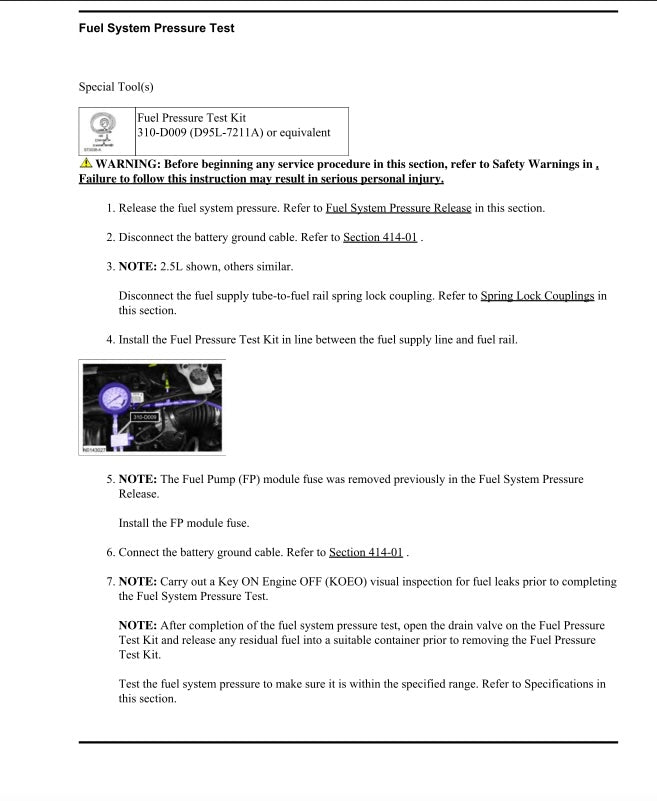
Sample pages and table of contents can be seen in the third product picture, please make sure you are happy with the quality of the manuals before purchasing.
If you have any issues downloading/accessing your manual, please contact us so we can fix this for you.
Share



Escape (2013-2019): The Redesign That Made Ford's Compact SUV a Rebadged European
The 2013 model year brought a genuine reinvention rather than a refresh — Ford completely dropped the boxy, Mazda-developed design of the first two Escape generations in favor of a rebadged version of the European Ford Kuga, built on the C1 platform shared with the Focus and related Volvo/Mazda products. It was the first Escape with nothing to do with Mazda's engineering, and the results showed: a claimed 10% improvement in aerodynamics over the outgoing generation, plus styling that finally read as crossover rather than boxy SUV.
Three four-cylinder engines anchored the lineup, all paired with a 6-speed automatic (Ford dropped the manual transmission entirely for this generation, and the long-running 3.0L V6 and Escape Hybrid were both discontinued). The base S trim ran a naturally aspirated 2.5-liter making 168 hp, while the SE and SEL stepped up to a turbocharged 1.6-liter EcoBoost four — the first Ford vehicle to offer this engine — delivering around 178 hp and 184 lb-ft of torque, matching the fuel economy of the previous-generation Hybrid model according to Ford's own claims. The range-topping Titanium trim carried a 2.0-liter EcoBoost turbo good for up to 240-245 hp and 270 lb-ft, more torque than the outgoing V6 ever produced. The dual-clutch PowerShift automatic transmission, notorious for reliability issues across other Ford models, was introduced on this generation as well — CarBuzz's own model history flags transmission failure as a common problem trend, particularly on 2014 models, often surfacing around 70,000 miles and running roughly $4,500 to repair.
The 2013 launch brought the MyFord Touch infotainment system, along with newly available features like a hands-free foot-activated liftgate and adaptive cruise control. A meaningful mid-cycle facelift arrived for 2016-2017: a redesigned front fascia with a chromed three-slat hexagonal grille, new fog lights, a revised tailgate and taillights, and — most significantly — the switch from MyFord Touch to the considerably more user-friendly Sync 3 system, which let owners remotely lock, start, and check on their vehicle through a smartphone app. The 2017 refresh also introduced a new 1.5-liter EcoBoost four-cylinder to replace the smaller 1.6-liter unit. This generation ran through the 2019 model year before the fully redesigned fourth-generation Escape arrived for 2020.
-
Manual Sourcing
We strive to use freely available sources. Some manuals may be scans or photocopies of older originals. Sample previews are shown on the product page, please review them before purchase to ensure quality meets your needs.
-
Copyright
This material is shared in accordance with the GNU General Public License (GPL), GNU Lesser General Public License (LGPL), or designated as Freeware, all of which allow free and open distribution. Additional information is available on our Copyright & Content Disclaimer Page
-
Refunds
Due to the nature of digital products, all sales are final. We recommend reviewing the sample preview on the product page to ensure the manual meets your expectations before purchase. Refunds will not be issued for issues related to content quality already disclosed or shown in the preview.
